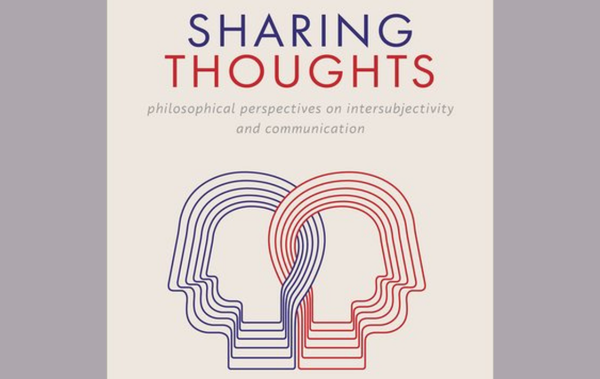
Review of Sharing Thoughts (eds. José Luis Bermúdez, Matheus Valente, and Víctor M. Verdejo)

This is a post by Valentine Simpson (University of Valencia).

You would be blameless for believing that a thought is a shareable thing. Indeed, it seems that subjects do a lot of thinking together, that they regularly exchange thoughts in communicating with each other, and that much (if not all) of what we accomplish as a society owes to our ability to pass information on to one another, in the form of my getting you to think that which I also think. Plausibly, this capacity is underpinned by our further sharing of a public language, with words and meanings that are also common to all.


Two Grounding Recipes for the New Physicalist

This is a post by Marcelino Botín (University of Barcelona) and Markel Kortabarria (University of Barcelona)

Consciousness is a rare beast. It is the aspect of reality with which we are most intimately acquainted, yet itremains strikingly resistant to scientific characterization. Classic thought experiments such as Mary in the black-and-white room suggest that one can possess complete scientific knowledge about the brain and still lack knowledge of what consciousness really is.

I Know How to Withstand the Skeptic

This is a post by Andrés Soria-Ruiz (University of Barcelona).

Think of the following: for all you know, you could be living in a computer simulation. Your friends might be so-called “Non-Player Characters”; your home, your surroundings might all be part of a sophisticated illusion. All of that is possible, and more worryingly, you—we—have no way of telling whether that’s actually the case.


Seeing Wrongness

This is a post by Josefa (Pepa) Toribio (ICREA, University of Barcelona).

Some actions strike us as right or wrong—as morally charged. For example, imagine you see someone helping an elderly person cross the street. You might immediately feel that this is a good action. Conversely, if you witness someone being rude to a cashier, you might instantly sense that this behaviour is wrong. When we recognize that an action is wrong, what does this recognition involve? How should we understand this sensitivity to basic moral properties?