This is a post by Federico Arena (University of Girona).
Imagine a judge delivering a verdict: “The State is obligated to provide healthcare to this patient.” We take this kind of statement for granted. But have you ever stopped to wonder what the judge is actually doing when they say this? Are they describing a fact about the world — the way you might say “It’s raining outside”? Or are they doing something entirely different?
This question sits at the heart of a centuries-old philosophical puzzle, and the answer turns out to matter quite a lot — not just for abstract theory, but for how we understand law, morality, and the limits of what philosophy can tell us about both.
Two Ways to Be a Skeptic
Moral and legal skeptics are united by one central claim: there are no normative facts “out there” in the world. When someone says “Torture is wrong” or “Citizens have a duty to pay taxes,” they are not describing some feature of reality the way you’d describe the fact that the door is closed. However, skeptics disagree sharply about what is happening instead.
On the one hand, expressivists say that duty statements aren’t descriptions at all. They function more like exclamations. When fans shout “Come on, Argentina!” at a football match, they aren’t stating a fact — they’re expressing enthusiasm. For the expressivist, moral and legal statements work similarly: judges use them in order to express attitudes of approval or disapproval and are neither true nor false.
On the other hand, error theorists take a different approach. They accept that duty statements look and function like descriptions. The trouble, they say, is that those descriptions are systematically false, because the facts they’d need to be true simply don’t exist. Think of someone confidently asserting “The King of France is bald.” There is no King of France, so the statement is false — not meaningless, just wrong. According to error theory, this is the situation with all duty statements: judges purport to describe a normative reality that never existed.
This distinction might seem technical, but it has real consequences: some criticisms of skepticism land differently depending on which version you’re attacking.
Duties in the Courtroom
One of the most influential objections to skepticism within the legal field comes from the philosopher H.L.A. Hart. His critique is essentially this: skeptics can’t explain what judges actually mean when they pronounce legal duties. When a judge says “This rule is valid,” Hart argues, they aren’t predicting their own behavior or expressing a vague feeling — they are recognizing the rule as meeting the criteria of the legal system and so as imposing a legal duty. That’s a genuine cognitive act, not a cheer.
The claim is that skepticism misrepresents judicial practice by failing to capture the intentions behind legal speech acts. If judges intend to describe legal reality, and skeptics say there is no such reality to describe, then either the judges are massively mistaken, or they are deceiving us. In both cases, the skeptical theory doesn’t fit.
My response in the paper is to push back on Hart’s premise. Do judges really intend to describe a pre-existing normative fact? If we follow Hart’s methodological requirement and observe what courts of last resort — paradigmatically Supreme or Constitutional Courts— actually do — shifting interpretive methods, deciding hard cases without clear answers, sometimes departing from what seems like the “obvious” reading of a statute — the picture looks less like fact-finding and more like norm-construction. Ironically, it may be Hart’s own theory that implies judges are frequently getting it wrong, not the skeptic’s.
Dworkin’s Challenge: Get in the Ring
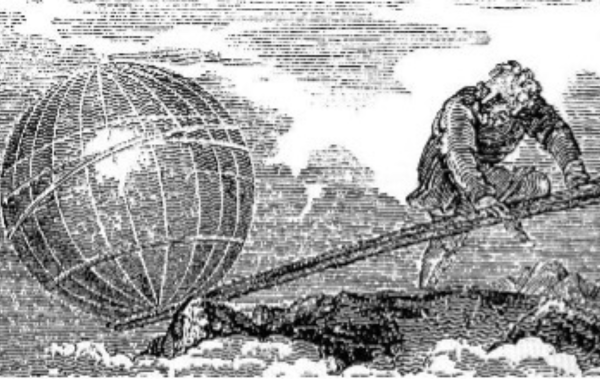
A second, more ambitious challenge to legal skepticism comes from Ronald Dworkin. His target is what he calls Archimedean skepticism — the idea that a philosopher can stand outside the moral or legal game, on neutral ground, and deliver a verdict about the whole enterprise without committing to any moral or legal position themselves.
Dworkin says this is an illusion. Any skeptical claim — “There are no normative facts,” or “Duty statements are neither true nor false” — can always be translated into a straight moral or legal claim. Say the skeptic asserts that the statement “Abortion should be permitted” is systematically false. Dworkin ultimately reads this as: “There are no reasons for or against abortion regulation.” But that itself is a moral claim — it’s a verdict on a moral question, not a view from nowhere. So the skeptic has secretly entered the very ring they claimed to be observing from the stands.
This is a clever argument. But it may prove too much. If every statement that touches on moral questions becomes a moral statement itself, then Hume’s famous observation that you can’t derive “ought” from “is” would also become a moral claim. Anthropological facts about how different cultures handle moral norms would become moral positions. The domain of morality would expand until it swallowed everything — and a domain without boundaries isn’t really a domain at all.
My argument is not that skepticism is right. It’s that neither Hart’s objection nor Dworkin’s succeeds in showing that it’s wrong.
Why It Matters
You might wonder: does any of this affect real life? It does, in at least one important way. If skepticism is defensible, it changes how we think about the authority of judicial decisions. Courts of last resort don’t simply find the law — they participate in making it. That’s not a scandal; it’s a feature. But it means that legal philosophy can’t afford to pretend that duty statements are straightforward descriptions of moral or legal facts waiting to be discovered. Understanding this is the first step toward a clearer picture of both law and morality.
To read more, see my article “Lo scetticismo giuridico e i suoi critici. Le due versioni dello scetticismo giuridico di fronte alle sfide ermeneutica e anti-archimedea” published in Notizie di Politeia, XLI, 160 (2025), pp. 5–24. The article is available for free here.
Federico Arena is an Independent Researcher at the National Scientific and Technical Research Council (Conicet) of Argentina and is currently a BIAP’s Postdoctoral Research Fellow at the University of Girona. He is a legal philosopher and has interests in legal theory and the relevance of stereotypes in legal reasoning. In recent years, he has been working on how to avoid the negative effects of stereotypes in legal reasoning. His work within BIAP is devoted to the analysis of how stereotypes and bias may affect the assessment of evidence within legal processes.

