This is a post by Josefa (Pepa) Toribio (ICREA – University of Barcelona).
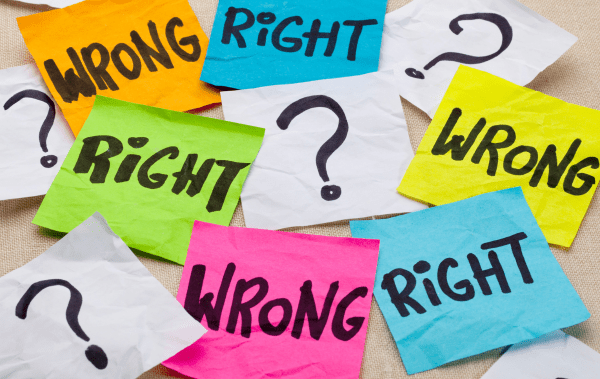
Some actions strike us as right or wrong—as morally charged. For example, imagine you see someone helping an elderly person cross the street. You might immediately feel that this is a good action. Conversely, if you witness someone being rude to a cashier, you might instantly sense that this behaviour is wrong. When we recognize that an action is wrong, what does this recognition involve? How should we understand this sensitivity to basic moral properties? A view that has lately gained some popularity in answering these questions is moral perceptualism. Moral perceptualism suggests that we can just see some basic moral properties, like the property of an action being right or wrong, in the same way we see other complex properties, such as the property of being a tiger.
Moral perceptualism has faced several criticisms. One argument is that moral qualities can’t directly impact our senses, and since perception relies on this direct impact, we can’t truly perceive them. Another criticism is that moral qualities don’t have a specific look or feel that makes them easy to recognize, unlike something like a tiger, which has a distinct appearance. Critics also say that we need a background of moral beliefs and knowledge to be sensitive to moral qualities, so perception alone isn’t enough to explain this sensitivity. Because of these issues, the idea that we can just see moral qualities is very controversial.
However, philosophers Jonna Vance and Preston Werner have proposed a new version of moral perceptualism that focuses on attention rather than perception. Their idea is that we recognize some basic moral properties by paying attention to salient features in our environment that make a moral difference in that situation, even though they are not moral properties themselves. They call these properties “moral difference-makers.” For example, seeing someone burn a cat’s tail draws our attention to the harm being done, which is a moral difference-maker, even though the burning itself is a
non-moral feature. According to this attention-based view, attention is sensitive to moral difference-makers and these attentional patterns shape our moral judgments and decisions.
Vance and Werner support their view with several studies from vision science. One of the experiments, run by Gantman and Van Bavel in 2014, showed that people can identify moral words more frequently than non-moral words when presented to them very briefly. This effect, called the “moral pop-out effect,” suggests that our attention is naturally drawn to morally significant features. However, if we examine carefully these results, all they show is that, while some attentional mechanisms are perceptual, the main explanation for our sensitivity to moral situations lies in cognition. This is evident in the case of the moral pop-out effect, which depends on the ability to recognize moral concepts. Yet, recognizing any concept requires understanding it. The increased sensitivity to moral issues seems to be best explained here by semantic priming. This is because the effect generalizes to other categories that include semantically related words.
The plausibility of attention-based moral perceptualism thus relies on avoiding a simplistic view of how perceptual attention works. It requires acknowledging that, while attention indeed facilitates (and at times hinders) perception, it involves a mix of both perceptual and cognitive processes. Attention is influenced by a complex interplay of bottom-up and top-down processing mechanisms that operate at different levels. We selectively process salient information, and salient information—either in the form of external stimuli or in the form of beliefs, expectations, and prior knowledge—captures our attention, shaping our resulting cognitive and behavioural responses.
Virtuous agents seem particularly sensitive to morally charged situations. Instances of right and wrong stand out in our experiences, but explaining a virtuous person’s sensitivity to these properties requires examining what drives their attention. The notion of “salience structure”, which is how accessible certain pieces of information are, is a useful tool for this explanation. Philosopher Jessie Munton uses this notion to explain prejudice, where certain social categories unjustly shape our attention. In our context, we can use this notion to show that the ability to recognize moral situations depends on properly organized salience structures around moral categories, just as prejudice depends on improperly organized salience structures around social categories. The key point is, again, that, while some attentional mechanisms are perceptual, the main explanation involves understanding the salience structure of information in terms of how accessible certain cognitive representations are.
To read more about his, check out Pepa’s article ‘Seeing Wrongness’, forthcoming in Journal of Moral Philosophy, where she discusses the idea of whether we can perceive (some) moral properties.
Pepa Toribio is an ICREA Research Professor at the University of Barcelona and is a member of BIAP and LOGOS. Her research focuses on issues in the philosophy of mind and the philosophy of cognitive science, with an emphasis on the perception and implicit bias.
 Open Philosophy