This is a post by Riin Kõiv (University of Barcelona).
Imagine being told that personality, performance in math, substance addiction, or excess body weight has genetic causes. For many, this information plants a sense of inevitability — as if their personality, their math performance, or their body weight were in some sense “determined,” beyond their own control.
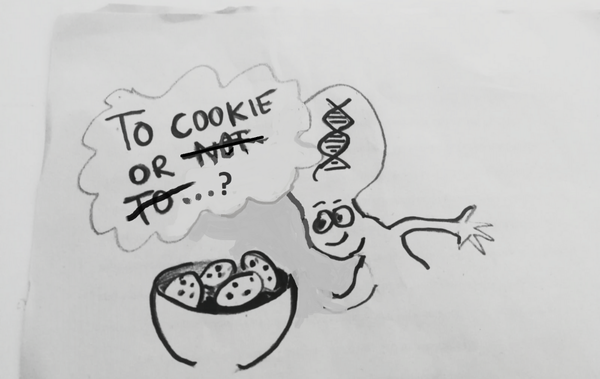
For example, in one study, participants read a vignette emphasizing the role of genetic factors in body weight gain. Afterwards, while waiting for the experimenter, they were left alone with a bowl of cookies. What they did not know was that their cookie consumption was being monitored. The result: those who had read the vignette ate about three times more cookies than those who had read about psychological causes of the same or had received no weigh-gain related information. The authors’ interpretation: information about genetic causes evoked a fatalistic, laissez-faire attitude toward weight gain, nudging people to indulge in the pleasures of cookie eating.
This image of genes “controlling” weight or any other behavioral trait is, of course, empirically false. Yet, this belief can function in a self-fulfilling way, amplifying the causal impact of genetic factors. Or so I argue in my paper.
In my birth country, Estonia, where winters are (still) cold, a common way to prevent road accidents is to spread salt on the roads when temperatures go below zero. Salt lowers the freezing point of water. As a result, ice forms less, cars and feet slip less, and accidents decline. In Estonia, salting roads causes fewer accidents. In warm wintery Florida where temperatures stay well above zero, it does not—whether or not you salt the roads, accident rates won’t change.
So too with genes. Many of the genes found to be associated with weight gain are thought to be involved with appetite regulation: people with certain alleles crave, and therefore eat, more calorie-rich food. However, these “appetite genes” only cause increased body weight if there’s calorie rich food around to be eaten. Where calorie rich food is not available, these same genes have no or little impact on body weight.
Consider another example. Estonia, today a democratic liberal market economy, was under Soviet Union rule until the union collapsed in 1991. A behavioral genetics study found that, after this event, the heritability of social outcomes such as educational and occupational success nearly doubled in the Estonian population — not because people’s genes changed, but because their social and ideological environment did.
These examples illustrate the trivial truth that in complex systems, whether one factor causes another depends heavily on context. And context (winter temperatures, nutritional and ideological environment) can change — and be changed. So, even if genes “determine” outcomes in certain contexts, it is often up to us to determine whether those contexts are present.
In my article, I elaborate on this idea. I argue that the relevant circumstances affecting whether, and how strongly, genes influence a trait can consist in what the science of genetics tells us about it. Gene–trait causal relationships are thus subject to what philosopher Ian Hacking famously called the “looping effect,” where scientific theories and classifications feed back into and reshape the very phenomena they describe. The looping effect is familiar in the social and psychological sciences. I suggest that it is likely to apply to human genetics as well.
Take cookies. Suppose that in a community of cookie-eaters the empirical finding “genes impact body weight” becomes common knowledge. These cookie-eaters are also genetic determinists. They misinterpret this finding as “My weight is out of my control,” and indulge in eating as many cookies as they crave. Yet some — those with appetite-increasing alleles — crave, and therefore eat, just a bit more. Over time, everyone in the community starts gaining weight, but the “good-appetite” individuals gain just a bit more. Soon, some of them who would have remained lean before learning “genes impact body weight” are no longer lean.
What this means is that the impact of “appetite genes” on weight gain is stronger in this genetically informed community – the “good-appetite” allele causes more of its carriers to gain more weight than it did when the genetic impact on weight gain was not known.
This toy example sketches a general mechanism: knowledge about genes having causal impact itself amplifies this impact.
That gene–trait relationships can be shaped by how people interpret and respond to scientific knowledge of these relationships is an important recognition.
First, it highlights another aspect of why empirical facts about genetic causation are contextual – often socially conditioned – rather than natural givens. This constrains their explanatory and practical use in a context where findings from behavioral and medical genetics are increasingly in supply and in demand.
Second, in the social and psychological sciences, the looping effect —that theories help create the very realities they describe—is long acknowledged to carry methodological, epistemological, and practical responsibilities. If human genetic research loops in a similar manner, it must likewise accept these responsibilities.
To read more, see my article, ‘Genetically caused trait is an interactive kind’ , which appeared in European Journal for Philosophy of Science in July 2023.
Riin Kõiv is a postdoctoral researcher at the University of Barcelona, specializing in philosophy of science. She has written on the concept of genetic information and genetic causation, the engineering of scientific concepts, and social construction.
 Open Philosophy